| From Strugglingteens.com Visit Reports (Academy at Swift River) I think I arrived at Rio Rapido in a condition similar to the other Academy at Swift River parents who were there – we weren’t sure what we were getting into, but we had already been on quite a journey! The same could be said for the ASR students, however they had already been there for four and half weeks prior to our arrival. On the final day of our time together, one of the parents admitted to me that she had been very put out at first that they had been strongly advised to spend the additional time and expense to go to Costa Rica for this final phase, after all they had already been through. Surely, she said, there must have been some other place in the states with a culture so remote and isolated, that it could have served the same purpose. However, by the end of her time there, she realized how absolutely essential it was to have joined the ASR students in Costa Rica, and why she “wouldn’t have missed it for the world.”
One of the metaphors I found to be extremely helpful was looking at a “disturbance” as an opportunity to create a “light gap.” Once again the metaphors found in ecology have relevance to how this same process happens in human relationships. When a disturbance, either natural or man-made, occurs in a primary forest, it creates a light gap, which results in new plant forms being allowed to emerge that can only grow under the new conditions the light gap creates. Some seeds in fact, like the mahogany, can lie dormant for eighty years until touched by sunlight. When I was talking with one of the counselors about how I’d always looked at the only benefit of a human “disturbance” or hardship in terms of its galvanizing effect, he pointed out that this often could become a way of hardening oneself. Instead, he suggested looking at disturbances as new opportunities and growth. The ASR counselors talked to the families about how the students have been in a program, but that it doesn’t end with graduation – the real task is to keep the communication channels open. Everyone can learn about themselves, regardless of their age. Communicating about themselves and listening to each other is the way families can continue to build their relationship over time. Experiencing the communication that was possible as a result of the work that these families had done was very inspiring to me. The parents reported this as well. One mother talked about how seeing the difference in her child from when first enrolled, to the present day was “almost like science fiction.” One staff member used the expression, “giving is receiving” and I could watch this in the parents’ eyes.
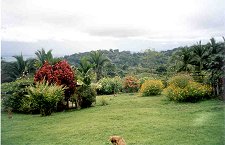
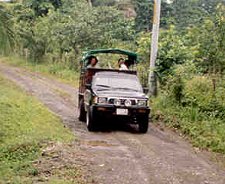
All too soon the week came to an end. We had experienced wonderful adventures in the rain forest around the ecologically diverse Osa Peninsula, second only to the Amazon in terms of biodiversity. We had attempted to communicate in faltering Spanish to the very kind and beautiful Costa Rican families where the students had stayed for a few days while doing service projects in previous weeks. I had ridden by horseback to Finca Miramar, a lovely, well-maintained farm and biological preserve and looked at the ocean from on top of the mountain. In a land where time seemed to move very slowly, suddenly it was time to take the group picture, and for parents to make preparations to soon return to the Massachusetts campus for graduation. The pickup-truck taxis hauled the eleven students back to Llante Picante, the retreat center where the workshops took place. As the group began to leave, I sat at the shore, looking at the fishing boats floating on the quiet waters of agua dulce, reflecting on the depth of communication I experienced with these families during our relatively brief time together. As part of their newly-acquired communication skills, they saw the benefit of maintaining a support network, and they kept in touch through a private web site and email. They intended to continue to support each other in this way after their students graduated, and perhaps the students would as well. ASR also had followup phone calls with counselors planned over the next year to continue to assist students in their transition.
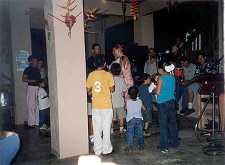
Soon a small airplane took off overhead, leaving with a large portion of the parents. I wondered if they felt ready for the next step. Even the night before, during the fiesta celebration with the local service-project families, I watched the emergence of a new issue: appropriate conduct in more relaxed, less structured settings. In one family this triggered old behaviors, causing hurt feelings. The very skilled ASR counselors helped them began to identify the triggers, and talked about ways to create future agreements about not detonating these triggers. It would be easy to wonder whether having this occur so late in the process was a sign that they are still not ready. Did this process miss its mark? Perhaps that could be one interpretation. What it illustrated to me, however, was that this work is about a process, not a magic wand, nor a silver bullet. Old patterns can always be triggered, old wounds re-opened, but now, it seems, there is an element of awareness – if not before the words have been uttered, then at least, soon thereafter, along with an acknowledgement of the need for an apology. It seemed to me that both students and parents had developed a greater understanding of the impact of their words as a result of their enhanced communication. Also, they now have the tools for beginning to rebuild the trust; the same tools that will help them talk about and apologize for their mistakes. Mistakes will probably occur, and they will not indicate a failure of the process. Their lack of practice in using their newly learned skills will of course engender less than perfect results. But these parents, I feel, have learned to start trusting the process. They have learned that it’s better to risk the discomfort of acknowledging the pain of each other’s mistakes, than to withdraw, isolate, and to resort to old ways of masking the pain. Perhaps they are beginning to see that masking the pain also masks the healing power of dialogue, which is what is needed to open the doors that will allow the love to flow. It is waiting on the other side of the emotional armor. Yes, it is frightening and frustrating, time consuming and hard for families to talk – hard to develop trust - and painful to have one’s expectations disappointed. Hopefully this process of building trust will not be based on the unrealistic belief that mistakes will never be made. The goal instead should be to build trust based on the willingness to communicate in order to reach a mutually agreeable plan. The lessons of Rio Rapido have illustrated how the disturbance in these families’ lives, that caused them to send their children to a program, created a light gap. Although it initially caused devastation, it has created the circumstances for a new kind of growth and closeness in the relationships in these families. Any dialogue about who is to blame for causing the disturbance perhaps only has relevance for preventing another disturbance. Understanding of the continuum of dependence and independence helps to show how each person’s actions affect everyone else. The families acknowledged that it was unrealistic to expect their children to call them on their cell phone to ask for support in resisting questionable behavior. Even so, checking in with one’s inner knowledge of the interdependence of the family system and the impact of one’s behavior on everyone else might help avoid making poor decisions. Developing awareness of one’s inner state can also can help adolescents identify when they are struggling. The enhanced trust and the love that can be revealed through this process of paying attention can provide both the adolescent and the parent the courage to ask for help and support. After all, as pointed out this week in Rio Rapido, it is one’s own responsibility to ask for help, it is not the fault of others for not knowing or asking. And yes, giving is receiving. Rio Rapido is a remarkable and unique adventure that helps families verbalize and practice the skills they have learned together while their child was attending Academy at Swift River. In a broader sense, it can provide all families with metaphors that can be used to learn how to live in better relationship with each other. © Copyright 2012 by Woodbury Reports, Inc. |