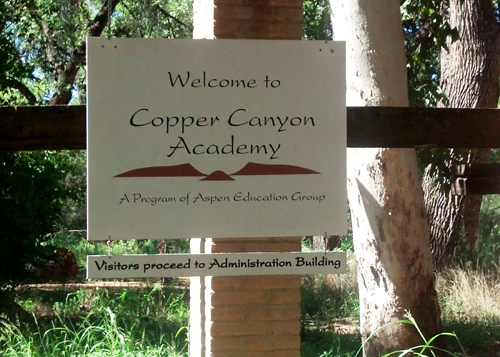
| From Strugglingteens.com Visit Reports Rimrock, AZ It had been seven years since my last visit, and there have been major changes to the property. What was virtually a vacant lot seven years ago with just preliminary plotting and excavations, is now the main part of the campus with most of the buildings clustered on what was a vacant lot. The main building housing dorms and administrative offices seven years ago is now just one of the dorms. Pathways wound between the buildings with tables scattered along the paths that would be perfect for outdoor discussions or therapy sessions. Below the main campus are the horse stables and facilities for the girls to ride if they wish, or participate in their equine therapy. Sniffing the slight breeze, I could sense a slight but not unpleasant whiff of animals close by and stables. All the grounds were clean and well kept, and the buildings freshly painted.
What hadn't changed was the ideal location, tucked away at the end of the road that goes through the small retirement town of Rimrock, giving privacy and a comfortable 'tucked in' impression. Down the little valley bordering the campus was undeveloped land, ensuring that no road would ever bring traffic by the school unless the traffic was destined for the school. A couple of years ago the school changed their licensure to become a Residential Treatment Center (RTC) with an optimum size of 90 girls licensed by the State of Arizona. They recently received their CARF accreditation, and the school is also fully accredited by the North Central Association Commission on Accreditation and School Improvement (AdvancED). The girls are organized into three "Houses," or dorms, with each being somewhat self-contained. This gives the advantage of much of each girls personal experience with the program is within a smaller group of girls living in their dorm and therapists and house staff assigned to each specific dorm. Each therapist is assigned a case load of no more than ten girls who provide ongoing therapy for the girls they are assigned to. In addition each house has two groups a week. Also, each girl participates in a specialty group once a week. These groups contain girls from all three dorms and each focuses on an issue the girls in that group need to work on. This is one of the exceptions to the program being "house" contained with the girls in their own dorm. School is the most common activity where the girls from all dorms interact together. Copper Canyon Academy has a college prep curriculum with flexibility to individualize the curriculum to the academic level of each student. The period of time devoted to academics is from about 8:30 AM to about 2:30 PM. They work very hard to not allow interruptions to the classes, working to schedule other activities and therapeutics outside of school hours, an indication of how serious they are about their academics. The curriculum is traditional with the material being presented in a traditional manner. I sat in a Shakespeare class where the girls were working on memorizing and interpreting portions of Shakespeare's more popular plays. The girls were attentive, prepared, and seem to be having fun with the subject matter. Another indication of how serious the school is about their academics is teachers are routinely represented in the weekly treatment team sessions. If a student is doing poorly in her academics, if she is not trying, or not doing the work, etc., then this is important information for the therapists to use. I was invited to sit in one of those treatment team meetings and one student's petition to advance a level was delayed because although the therapist was pleased with her therapeutic progress, a poor performance in her academic effort was sufficient to hold her back. The goal is to have the therapists and the teachers working jointly as a team. Another group of staff are the residential staff. They are assigned to specific dorms and probably these people spend more time with the girls than either the teachers or therapists. I met with three house supervisors and all had been with Copper Canyon Academy four years or longer, indicating longevity, and they assured me the school recognizes the importance of these front line staff that have to deal with daily living with a group of teenage girls, complete with drama, upsets, downers as well as joys and successes. They assured me the house staff is reasonably paid and their input is important to treatment decisions. One unique aspect of their program is what they call their Transitional Living program. Unlike the Transitional programs of other schools, the purpose here is for these girls to live apart from the others for a time in a more independent setting in preparation for home visits. Thus, it is a temporary situation focusing on an important event in a girl's program, and after the home visit the girls return back to their house. The school has three Workshops, each being a milestone in the program, and each lasting three days. They estimate each participant spends about 30 hours in each. Also, both parents and the girls go through them as the girls work their way through the program. Workshop #1 is heavily experiential, focusing on helping them to learn to listen to themselves and to enhance their self-awareness. The girls and the parents each have their own separate workshop. The students I talked with told me workshop number one and three were very intense, that is, pretty emotional. Workshop #2 is more educational, focusing on providing an opportunity to look at their relationships. Most of the material comes from the Arbinger Institute. Again, parents and girls each have their own separate sessions. Workshop #3 becomes more intense emotionally, with the girls and their parents experiencing them together. The premise is they are no longer looking at the past, but the orientation is to look forward. I presume this would mean part of the function would be to consolidate what they have learned so far in preparation for the future. I did have a chance to visit with four students for some time. They were articulate, knew their own minds, were well on their way to developing plans for their futures, and had some definite ideas about how their experience at Copper Canyon Academy could have been made better as well as what it had done for them. From the emotional place they were at when they enrolled, it was obvious they had come a long ways. © Copyright 2012 by Woodbury Reports, Inc. |